

UK Businesses Need Strong Growth Strategies Beyond Tax Rises
With the UK tax burden forecast to rise significantly toward the end of the decade, business owners and finance leaders are questioning whether further fiscal increases will strengthen the economy or restrict private investment. More tax or more growth? It is a defining question for modern enterprises navigating an unpredictable fiscal landscape.
The Office for Budget Responsibility (OBR) highlights that the UK tax-to-GDP ratio continues an upward trajectory, creating financial pressure across corporate balance sheets. Although taxation funds vital public infrastructure, higher employment costs, elevated Corporation Tax rates, and frozen personal thresholds directly influence operational recruitment and capital investment decisions.
According to economic indicators published by the Office for National Statistics (ONS), macroeconomic momentum remains mixed, proving that sustainable expansion requires far more than government policy adjustments.
Essential Ways UK Businesses Need to Drive Growth Beyond Tax Rises
To thrive despite fiscal headwinds, UK Businesses Need to implement seven core operational strategies:
1. Shift Focus from Macro Policy to Internal Financial Discipline
Businesses cannot control government policy, tax thresholds, or macroeconomic cycles. What they can control is how efficiently capital moves through their organization. Shifting focus from external lobbying to internal financial discipline ensures stability under any political climate.
2. Maintain Robust Cash Flow Reserves and Rolling Forecasts
Maintaining healthy cash buffers acts as the ultimate shock absorber. Leaders should implement rolling cash flow forecasts that model multiple scenarios — including higher payroll costs or unexpected tax liabilities — to eliminate sudden liquidity crunches.
3. Stress-Test Budgets Against Rising Employment Costs
With statutory wage increases and National Insurance pressures squeezing profit margins, organizations must evaluate labor productivity and pricing models regularly to protect gross profitability.
4. Optimize Capital Allowances and Investment Timings
Changes to capital allowances, such as adjustments to writing-down allowances and full expensing rules, mean transaction timing matters. Aligning equipment purchases and technology upgrades with tax relief schedules optimizes cash flow.
5. Leverage Cloud Automation and Real-Time Management Data
Outdated spreadsheets invite costly errors. Integrating automated cloud accounting systems provides leadership with instant visibility over spending, margins, and operational bottlenecks.
What UK Businesses Need in the Current Economic Climate
At its core, the debate between taxation and expansion centers on how mid-market firms maintain liquidity amid increasing friction.
UK Gross Domestic Product (GDP) grew by 0.5% during the second quarter, while business investment increased by 1.8%. However, monthly growth slowed to 0.1% later in the period, signaling that sustainable economic success depends heavily on internal productivity, digital infrastructure, skilled talent, and unwavering business confidence.
The Tax Burden Is Rising
Use a rising tax graph beside a business owner to show increasing financial pressure.
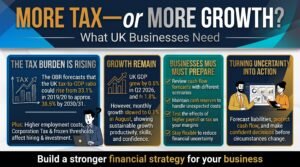
The OBR forecasts that the UK tax-to-GDP ratio could rise from 37% in 2019/20 to approximately 43% by 2030/31.
Although taxes fund essential services, higher employment costs, Corporation Tax and frozen personal thresholds can affect recruitment and investment decisions.
Growth Remains Uneven
Show contrasting economic indicators to represent an economy producing mixed results.
UK GDP grew by 0.5% during the second quarter of 2026, while business investment increased by 1.8%.
However, monthly growth slowed to 0.1% in August. Sustainable growth therefore requires more than tax changes—it also depends on productivity, infrastructure, skills and business confidence.
Businesses Must Prepare
Use a cash-flow forecast with different scenarios to demonstrate forward planning.
Businesses cannot control government policy, but they can prepare for different outcomes.
Reviewing forecasts, maintaining cash reserves and testing the effects of higher payroll or tax costs can reduce financial uncertainty.
Turning Uncertainty into Action
Show an accountant reviewing financial plans with a business owner to highlight proactive support.
Modern accountants do more than calculate tax. They help businesses forecast liabilities, protect cash flow and make confident decisions before circumstances change.
At Ten Piece Limited, we help businesses plan for tax changes and build stronger financial strategies.
This article provides general information and does not constitute personalised advice.
Partner with Proactive Financial Advisors
Modern accountants do more than calculate year-end tax liabilities. Strategic advisors help businesses forecast liabilities, protect cash flow, and make confident decisions before circumstances change.
To explore how modern advisory structures support enterprise expansion, read our detailed UK Accounting Services Guide or learn how automation streamlines workflows in our Accounting Automation article.
Final Thoughts: Turning Uncertainty into Action
Uncertainty is an inevitable part of the modern economic landscape, but vulnerability is optional. Businesses that pair disciplined cost control with forward-looking planning position themselves to capture market share regardless of fiscal changes.
At Ten Piece Limited, we help businesses plan for tax changes and build stronger financial strategies that turn uncertainty into measurable growth.
Learn more about our practice on our About Us page, explore our full suite of Services, or Contact Us today to future-proof your business.