


If you own a small limited company in the UK, one of the first questions you may ask when looking for an accountant is: how much should I expect to pay?
Some accountants advertise monthly packages, while others charge an annual fee for preparing statutory accounts and Corporation Tax returns. You may also find that bookkeeping, VAT returns, payroll and personal tax returns are charged separately.
This makes it difficult to compare quotations. A company paying £60 per month may receive a very different service from one paying £180 per month.
In this guide, we explain how much an accountant typically costs for a small limited company in the UK, what affects the price, which services may be included and how to assess whether an accounting fee represents good value.
1. Expert Answer: How Much Does an Accountant Cost for a Small Limited Company?
There is no fixed government tariff for accountancy services. Each accounting practice sets its own fees based on the work required, the complexity of the company and the level of support provided.
As an indicative 2026 UK market guide, the following ranges can help small company directors understand what they may be quoted.
Typical accountant costs in the UK
| Type of accounting service | Indicative cost |
|---|---|
| Basic year-end accounts and Corporation Tax support | £500–£1,500 per year |
| Basic monthly accounting package | £60–£120 per month |
| Monthly package with VAT and payroll support | £120–£250 per month |
| More comprehensive accounting and advisory support | £250+ per month |
| Additional director’s Self Assessment | Often £150–£400 per year |
| Quarterly VAT return, if charged separately | Often £40–£150 per return |
These are broad market indications, not guaranteed quotations or official averages. Providers use different definitions of what is included, and some prices are advertised excluding VAT.
A company should therefore compare the actual services and total annual cost rather than relying on the headline monthly fee.
Example 1: A straightforward one-director limited company
Suppose you operate a small consultancy through a limited company.
Your circumstances are:
- One director.
- No employees.
- Not VAT registered.
- A relatively low number of monthly transactions.
- You maintain your own bookkeeping records.
- You need annual accounts and a Corporation Tax return.
Your accounting requirements are relatively straightforward. You may find a basic annual compliance package sufficient, provided you understand what is excluded and have access to support when necessary.
An indicative budget might be £60–£120 per month, or £720–£1,440 per year.
Example 2: A VAT-registered limited company
Now consider a small trading company that:
- Has one director and two employees.
- Is VAT registered.
- Processes regular sales and purchase transactions.
- Requires quarterly VAT returns.
- Needs monthly payroll.
- Wants regular bookkeeping support.
This company requires more ongoing work than the first example.
The accountant may need to reconcile transactions, review VAT treatment, prepare payroll submissions, monitor records, and complete the year-end accounts and Corporation Tax return.
An indicative monthly budget could be £120–£250 or more, depending on transaction volumes and the amount of bookkeeping included.

Example 3: A company requiring more extensive support
A growing company may have several employees, multiple income streams, higher transaction volumes, stock, overseas transactions or more complicated director remuneration arrangements.
It may also need management accounts, cash-flow reporting and regular tax planning.
In these circumstances, fees may exceed £250 per month because the accountant is providing a broader service rather than simply preparing year-end accounts.
2. What Services Should an Accountant’s Fee Include?
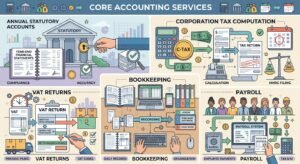
Before accepting a quotation, establish exactly what the accountant will do.
The following services are commonly offered to limited companies, but they are not automatically included in every package.
Annual statutory accounts
Preparation of the company’s annual accounts in accordance with the applicable reporting requirements and filing them with Companies House.
Corporation Tax computation and CT600
Preparing the Corporation Tax calculation and Company Tax Return and submitting the return to HMRC.
Bookkeeping
Recording income and expenditure, reconciling bank transactions, maintaining ledgers and organising financial records.
VAT registration and returns
Advising on VAT registration and preparing and submitting VAT returns where the company is registered.
Payroll and PAYE
Processing director and employee salaries, producing payslips and submitting the required payroll information to HMRC.
Director’s Self Assessment
Preparing the director’s personal tax return where required. This is often a separate service, even when the company already has an accountant.
Tax planning and business advice
Discussing matters such as salary and dividends, director’s loan accounts, allowable expenses, cash flow and business decisions.
Management accounts
Preparing periodic financial reports to help directors understand income, expenditure, profitability and financial performance.
Always confirm whether these services are included, restricted by transaction volume or charged separately.
3. What Factors Affect the Cost of an Accountant?
Two companies with similar turnover can receive very different accounting quotations. Turnover is only one consideration.

1. Number of transactions
A company processing 30 transactions per month will generally require less bookkeeping work than one processing 500 transactions.
2. VAT registration
VAT registration creates additional reporting and record-keeping requirements. The number and complexity of VAT transactions can affect the fee.
3. Number of employees
Payroll for one director is usually simpler than payroll for a company with several employees, pension contributions, starters and leavers.
4. Quality of bookkeeping records
Well-maintained records in accounting software can reduce the time required to prepare accounts. Incomplete records or unreconciled bank transactions may require additional work.
5. Business activities
A consultancy with straightforward service income may have different accounting requirements from a restaurant, construction company, retailer or e-commerce business.
6. Director’s personal tax affairs
A director with rental income, overseas income, investments or other taxable income may need additional Self Assessment work.
7. Level of support
Some companies only need annual compliance. Others want regular meetings, management reports, tax planning and ongoing access to an accountant.
The more work and responsibility included in the engagement, the more likely the fee will increase.
4. Monthly Accounting Fees vs Annual Accounting Fees
Accountants may offer a monthly subscription or a one-off annual fee.
Neither structure is automatically cheaper. The important consideration is what work is covered.
| Monthly package | Annual fee |
|---|---|
| Spreads the cost across the year | One larger payment or staged payments |
| Can include ongoing bookkeeping and support | May focus mainly on year-end compliance |
| Helps with budgeting | May suit companies with simple requirements |
| Check the minimum contract period | Check what happens when additional work is needed |
For example, a quotation of £90 per month amounts to £1,080 over 12 months. A one-off annual quotation of £750 may initially appear cheaper.
However, if the annual quotation excludes bookkeeping, VAT, payroll and routine advice, the monthly package may offer better overall value for a company that needs those services.
Always compare the complete annual cost.
5. Are Accounting Fees Tax Deductible?
Generally, accountancy fees incurred wholly and exclusively for the purposes of the company’s trade are allowable business expenses when calculating taxable profits.
However, fees relating to personal tax affairs or other non-business matters should not automatically be treated as deductible company expenses. The treatment depends on what the work relates to and who incurred the liability.
For example, a fee for preparing a company’s statutory accounts and Corporation Tax return will normally be a company expense. A director’s personal Self Assessment fee needs to be considered separately.
Where an invoice covers both company and personal work, the costs should be appropriately identified and treated.
6. Common Mistakes & Pitfalls When Comparing Accountancy Fees
 Choosing the cheapest accountant without checking the scope
A low monthly price may cover only annual accounts and Corporation Tax. You could face additional charges for bookkeeping, VAT and payroll.
Comparing monthly prices without calculating the annual cost
£75 per month is £900 per year. Add separate VAT, payroll or Self Assessment fees and the total can change considerably.
Assuming accounting software is included
Some practices include software in their packages, while others charge separately. Confirm who pays for the subscription and who controls the account.
Not asking about additional work
Catch-up bookkeeping, historical corrections, HMRC enquiries and specialist tax advice may fall outside the standard engagement.
Ignoring transaction limits
A package may cover a limited number of transactions. If your business grows, the fee may need to be revised.
Assuming the accountant’s fee includes statutory filing charges
Companies House filing fees are government charges, not accountancy fees. Confirm whether these are included in the quotation or billed separately.
Waiting until the deadline to appoint an accountant
Late appointments can lead to urgent work, incomplete records and additional costs. Organising accounting support early is usually more effective.
7. Practical Recommendations: How to Get a Fair Accounting Quote
Before approaching an accountant, prepare the following information:
- Company name and company registration number.
- Approximate annual turnover.
- Number of monthly sales and purchase transactions.
- Whether the company is VAT registered.
- Number of directors and employees.
- Whether payroll is required.
- Whether bookkeeping is already up to date.
- Which accounting software you use.
- Whether directors need personal Self Assessment returns.
- Whether you need ongoing advice or only year-end compliance.
Then ask each accountant to quote for the same scope of work.
A useful question to ask is:
“Can you confirm the total annual cost and list everything included, everything excluded and any additional charges I might incur?”
You should also ask:
- Who will handle your accounts?
- How often will your bookkeeping be updated?
- Are VAT returns and payroll included?
- Is software included?
- Are routine accounting queries covered?
- What happens if transaction volumes increase?
- Are there additional charges for onboarding or catch-up work?
A good quotation should be clear enough for you to understand exactly what you are paying for.
Ten Piece Limited (TPL) – The Trusted Accounting Partner
Ten Piece Limited is licensed and regulated by the AAT (License No. 1009076) and supervised under HM Treasury Money Laundering Regulations. Ten Piece Limited – The Trusted Accounting Partner. Based in London, we provide professional accounting, taxation, and business advisory services to individuals, sole traders, entrepreneurs, start-ups, company directors, and businesses across London, Greater London, and throughout the UK. Our services include bookkeeping, VAT registration and returns, payroll management, annual accounts, Corporation Tax returns, Self Assessment, tax planning, financial reporting and Xero accounting support. We believe everyone deserves access to professional accounting advice, regardless of their income, occupation, financial circumstances or source of earnings. Whether you run an established company, are starting your first business, work as a freelancer, earn through content creation or have multiple income streams, our approachable and non-judgemental team is here to listen, understand your circumstances and provide practical, tailored advice. We pride ourselves on being easy to talk to, offering clear guidance and treating every client’s personal and financial information with the utmost confidentiality and discretion, subject to applicable legal and regulatory obligations. Whether you are looking for a reliable accountant in London, affordable accounting services for your limited company, better bookkeeping support, professional tax advice or a new accountant who genuinely understands your needs, Ten Piece Limited is here to help. Contact us today for a personalised quotation and discover accounting support built around you and your business.
Engagement & Call to Action
Ready to simplify your accounting processes and optimize your tax strategy?
Contact Ten Piece Limited today at +44 20 8050 5527, email hello@tenpiece.co.uk, or visit tenpiece.co.uk to request a customized quote or schedule a consultation with our expert team.