

Six Assets That Can Escape Capital Gains Tax
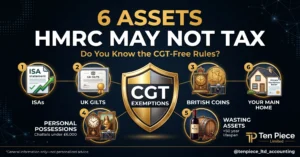
Capital Gains Tax (CGT) does not apply to every profitable asset disposal. Understanding which assets are free from capital gains tax allows UK taxpayers, business owners, and investors to structure their wealth efficiently while remaining fully compliant with HMRC rules.
Several assets benefit from valuable exemptions—but only when specific statutory conditions are met. Below is a practical guide to six key asset classes that can escape CGT in the UK.
ISAs and UK Government Gilts
Gains, interest, and dividends generated within an Individual Savings Account (ISA) are completely tax-free, provided the annual subscription limits and ISA rules are followed. Whether holding stocks and shares, cash, or innovative finance ISAs, any growth achieved within the wrapper remains free from capital gains tax upon withdrawal or sale.
For investors building long-term wealth, maximizing your annual ISA allowance should be a primary consideration before holding taxable assets.
Legal-Tender Coins and Personal Possessions
Show British coins, artwork and jewellery to demonstrate how different assets receive different tax treatment.
Sovereigns minted from 1837 onwards and Britannia coins are normally exempt because they are UK legal tender. This exemption does not automatically cover gold bars, jewellery or foreign coins.
Personal possessions sold for £6,000 or less are also generally exempt. However, matching items may be treated as a set, meaning their combined value could be considered.
Wasting Assets
Use wine, machinery and other time-limited assets to explain the wasting-asset exemption.
An asset with a predictable useful life of 50 years or less may qualify as a wasting asset. Gains can be exempt, although restrictions may apply where capital allowances were available or claimed.
Your Main Home and the Value of Planning
Show a homeowner consulting an accountant before selling a property.
Private Residence Relief can protect the gain made when selling your main home. Relief may be restricted if the property was rented out, partly used exclusively for business or not occupied as the main residence throughout ownership.
Tax exemptions depend on how an asset is owned, used and sold. Professional planning can help establish which reliefs apply and prevent unexpected liabilities.
At Ten Piece Limited, we help individuals and business owners understand Capital Gains Tax and plan disposals with confidence.
This article provides general information and is not personalised tax or investment advice.
Qualifying UK Government Gilts
Disposing of qualifying UK government bonds (gilts) offers another significant tax advantage. Gains made on the sale or redemption of qualifying gilts are legally free from capital gains tax.
However, investors must note that while the capital growth on gilts is exempt from CGT, any coupon or interest payment generated outside an ISA wrapper may still be subject to UK Income Tax.
UK Legal-Tender Sovereign and Britannia Coins
Precious metal investments receive varied tax treatment under UK law. Standard gold bars, silver bullion ingots, foreign coins, and jewellery are typically subject to standard CGT rules upon disposal.
However, British coins designated as UK legal tender—such as Sovereigns minted from 1837 onwards and Britannia coins—are classified as currency. As a result, gains realized on these legal-tender coins are entirely free from capital gains tax, making them a popular choice for physical metal investors.
Protect Your Portfolio with Ten Piece Limited
Tax exemptions depend heavily on how an asset is structured, held, and disposed of. At Ten Piece Limited, we assist individuals and company directors across the UK in optimizing their tax position and managing CGT exposures safely.
Explore our complete range of services on the Ten Piece Limited Homepage or contact our advisory team directly. You can also verify official capital gains tax allowances directly on the GOV.UK Capital Gains Tax Guidance portal.
Disclaimer: This guide is provided for informational purposes only and does not constitute formal financial or tax advice. Always speak with a qualified accountant before making asset disposals.