


Choosing an accountant involves more than comparing fees or finding a practice with a professional-looking website. You are trusting someone with financial records, tax returns, business information, and important compliance responsibilities.
But how can you tell whether an accountant is properly qualified?
In the UK, the word “accountant” is not, by itself, proof of a professional qualification. Anyone can describe themselves as an accountant, even if they have not completed a recognised accountancy qualification.
That does not mean every unqualified accountant provides a poor service. However, business owners should understand the difference between experience, professional qualifications, membership of an accountancy body and authorisation to provide particular services.
The safest approach is to verify the individual’s credentials directly with the relevant professional body and check that the practice is authorised to provide the services you need.
1. How to Confirm Your Accountant’s Professional Credentials
There are several practical ways to establish whether an accountant has recognised qualifications and the appropriate professional status.

A. Ask which professional qualification they hold
Start by asking the accountant to identify their qualifications and the professional body that awarded them.
Common UK accountancy qualifications and professional bodies include:
- AAT – Association of Accounting Technicians: Offers professional qualifications and membership grades, including AATQB, MAAT and FMAAT.
- ACCA – Association of Chartered Certified Accountants: Awards the Chartered Certified Accountant qualification to members who have met its membership requirements.
- ICAEW – Institute of Chartered Accountants in England and Wales: Awards the ACA qualification and regulates its members and firms.
- ICAS – Institute of Chartered Accountants of Scotland: Awards the CA qualification.
- CIMA – Chartered Institute of Management Accountants: Offers professional qualifications focused on management accounting and business finance.
- CIPFA – Chartered Institute of Public Finance and Accountancy: Specialises in public finance and public sector accountancy.
These bodies have different membership requirements, qualifications and professional scopes. They should not be treated as interchangeable simply because they operate within the accounting profession.
B. Verify their membership through the official directory
Do not rely only on a certificate displayed on a website or in an office. Check the individual’s name through the professional body’s own verification service.
Useful official directories include:
AAT
Use the AAT directory to find licensed accountants and bookkeepers. You can check whether the practice is listed and which services it is licensed to provide.
Directory: https://www.aat.org.uk/businesses-employers/find-accountant-bookkeeper
ACCA
Use ACCA’s member directory to search for an individual member. If the accountant provides general accountancy services in public practice, check whether the relevant practising certificate is held.
Directory: https://www.accaglobal.com/gb/en/member/find-an-accountant/directory-of-member.html
ICAEW
ICAEW provides a directory to verify members and accountancy firms. Its membership verification service can also show whether a member holds an ICAEW practising certificate.
Directory: https://www.icaew.com/about-icaew/find-a-chartered-accountant
ICAS
If someone describes themselves as a Scottish Chartered Accountant, check their membership and status directly with ICAS.
The principle is simple: use the professional body’s own records rather than relying solely on information supplied by the accountant.
C. Check whether they are a member, student or fully qualified professional
This distinction is particularly important.
Someone studying towards an accountancy qualification is not automatically a fully qualified member of that professional body.
For example, the following descriptions are not equivalent:
- AAT student.
- AATQB – AAT bookkeeping member.
- MAAT – AAT full member.
- FMAAT – AAT fellow member.
- ACCA student.
- ACCA affiliate.
- ACCA member.
- ICAEW ACA student.
- ICAEW Chartered Accountant.
Ask the accountant to explain their exact membership status.
If they use professional letters after their name, ask what those letters mean and verify that the membership is current.
D. Check whether they hold a practising certificate or professional licence
Having a qualification and being authorised to practise are not necessarily the same thing.
Some professional bodies impose additional requirements on members who provide services to the public.
For example, AAT requires self-employed members offering bookkeeping or accountancy services to clients to hold an appropriate AAT licence, unless a recognised exemption applies.
AAT offers two principal licence types:
AAT Licensed Bookkeeper
A licensed bookkeeper can be approved to provide specified bookkeeping and related services, subject to the scope of their licence.
AAT Licensed Accountant
A licensed accountant can apply for approval to provide a broader range of services, including certain tax, accounts preparation and advisory services.
Importantly, the services an AAT member can provide depend on the specific services approved under their individual licence. Having MAAT membership alone does not automatically mean that every service is authorised.
ACCA also distinguishes between membership and practising status. Its guidance states that members providing general accountancy services to individuals or businesses must hold an ACCA practising certificate, subject to the applicable rules and exemptions.
ICAEW also provides a way to verify whether a member holds a practising certificate.
Therefore, ask two separate questions:
- What professional qualification and membership do you hold?
- Are you authorised to provide the particular services I need?
E. Check anti-money laundering supervision
Accountancy service providers carrying out activities covered by the Money Laundering Regulations must have the appropriate anti-money laundering supervision.
Depending on the practice and its professional membership, the supervisor may be HMRC or an eligible professional body.
Ask the accountant:
- Which organisation supervises the practice for AML purposes?
- Is the supervision currently active?
- Can the practice provide evidence of its supervision?
- Does the public register show the correct business?
HMRC’s guidance explains that professional tax advisers must meet relevant registration conditions, including providing evidence of appropriate AML supervision where required.
AML supervision is an important regulatory safeguard, but it is not the same as an accountancy qualification. Check both separately.
F. Ask about professional indemnity insurance
Professional indemnity insurance can provide protection against certain claims arising from professional negligence or errors, subject to the policy’s terms, conditions and exclusions.
Ask whether the accountant’s practice holds appropriate cover for the services it provides.
You can also ask:
- Which legal entity is insured?
- Does the policy cover the work being undertaken?
- Is the cover current?
- Are there any relevant limitations or exclusions?
For example, a firm may provide bookkeeping, payroll and tax services, but you should not assume that its insurance automatically covers every possible professional service.
Some professional bodies require practising members or licensed firms to hold appropriate professional indemnity insurance.
G. Check whether their qualifications match the services you need
A professional qualification does not automatically authorise someone to undertake every regulated or specialist activity.
For example:
- Preparing bookkeeping records is different from providing specialist tax advice.
- Preparing company accounts is different from carrying out a statutory audit.
- Payroll processing is different from providing employment law advice.
- General tax compliance is different from specialist tax planning involving complex transactions.
If you need a statutory audit, for example, check that the firm and responsible individuals have the appropriate audit registration and authorisation.
Similarly, if you require insolvency, legal or other regulated services, verify the relevant specialist authorisation.
Do not assume that an accountant can provide every service simply because they hold a professional qualification.
H. Review their experience and continuing professional development
Qualifications are important, but practical experience also matters.
Ask whether the accountant regularly works with businesses similar to yours.
For example:
- A restaurant may need an accountant familiar with VAT, payroll, stock and daily takings.
- A construction company may need support with industry-specific tax and compliance requirements.
- An online retailer may need experience with payment platforms, stock and overseas transactions.
- A contractor may need advice on IR35 and relevant employment tax issues.
- A small limited company may need support with annual accounts, Corporation Tax, director payroll and dividends.
Also ask how the accountant maintains their professional knowledge.
Members of professional bodies are generally subject to continuing professional development requirements. This helps them keep their technical knowledge current as tax legislation, accounting standards and professional requirements change.
2. Practical Example: Verifying an Accountant Before Appointment
Imagine you are appointing an accountant for your limited company.
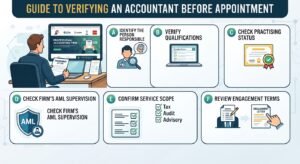
One practice advertises itself as a professional accounting firm and displays several qualification logos on its website.
Before signing an engagement letter, you should:
A. Identify the person responsible for your work
Ask who will prepare and review your accounts and tax returns.
B. Verify their qualifications
Search the relevant professional body’s directory using their name and membership details.
C. Check practising status
If their professional body requires a practising certificate or licence for the work being offered, verify that it is current.
D. Check the firm’s AML supervision
Ask which body supervises the practice and request evidence where appropriate.
E. Confirm the service scope
Check that the person and practice are authorised and competent to provide the services you require.
F. Review the engagement terms
Make sure the engagement letter identifies the services, fees, responsibilities and any exclusions.
This process does not guarantee that an accountant will never make a mistake. However, it helps you make a more informed decision before handing over responsibility for important financial work.
3. Common Mistakes & Pitfalls When Checking an Accountant

A. Assuming anyone using the title “accountant” is qualified
In the UK, the general title “accountant” is not protected in the same way as certain professional titles.
Ask for specific qualifications and verify them.
B. Confusing student status with full membership
An individual studying towards ACCA, AAT or another qualification should not be assumed to have completed it.
Check the exact membership grade.
C. Assuming membership automatically means practising permission
Some professional bodies require additional authorisation for members working in public practice.
Verify the practising status relevant to the services being offered.
D. Checking only the individual and not the firm
The individual may hold a qualification, but the firm may still need separate permissions, registrations or supervision.
Check both where relevant.
E. Assuming AML supervision proves professional qualification
AML supervision and professional qualifications are separate matters.
A practice may have AML supervision without the owner holding a particular accountancy qualification. Equally, professional membership does not remove the need for appropriate AML supervision where the regulations apply.
F. Failing to check specialist authorisations
Not every accountant can carry out statutory audits or other regulated work.
Verify the relevant authorisation before engaging a firm for specialist services.
G. Relying on certificates without checking their current status
A certificate may be old, expired or no longer reflect the individual’s membership status.
Use the professional body’s current directory or verification service.
H. Assuming qualifications guarantee excellent service
Qualifications are important, but they do not guarantee timely communication, accurate work or a good client experience.
Consider experience, quality-control processes, insurance, communication and references as well.
4. Practical Recommendations & Next Steps
Before appointing an accountant, use this checklist.
A. Request their full professional credentials
Ask for the exact qualification, professional body and membership grade.
B. Verify the credentials independently
Use the official directory of the relevant professional body.
C. Check practising permission
Confirm whether the individual and practice hold the licences or certificates needed for the services being offered.
D. Confirm AML supervision
Establish which supervisory body covers the practice and whether its supervision is current.
E. Ask about professional indemnity insurance
Request confirmation that appropriate cover is maintained.
F. Check relevant experience
Ask whether the accountant regularly works with businesses of your size, structure and industry.
G. Review the engagement letter
Ensure the work, fees, responsibilities and exclusions are clearly documented.
H. Keep responsibility for your own tax affairs
HMRC makes clear that appointing a tax agent does not remove your responsibility for your tax affairs. Review your returns and do not sign a blank tax return for an agent to complete.
A properly qualified and appropriately authorised accountant can provide valuable support, but you should still understand what work they are undertaking on your behalf.
Ten Piece Limited (TPL) – The Trusted Accounting Partner
Ten Piece Limited is licensed and regulated by the AAT (License No. 1009076) and supervised under HM Treasury Money Laundering Regulations. Ten Piece Limited – The Trusted Accounting Partner. Based in London, we provide professional accounting, taxation and business advisory services to individuals, sole traders, entrepreneurs, start-ups, company directors and businesses across London, Greater London and throughout the UK. Our services include bookkeeping, VAT registration and returns, payroll management, annual accounts, Corporation Tax returns, Self Assessment, tax planning, financial reporting and Xero accounting support. We believe everyone deserves access to professional accounting advice, regardless of their income, occupation, financial circumstances or source of earnings. Whether you run an established company, are starting your first business, work as a freelancer, earn through content creation or have multiple income streams, our approachable and non-judgemental team is here to listen, understand your circumstances and provide practical, tailored advice. We pride ourselves on being easy to talk to, offering clear guidance and treating every client’s personal and financial information with the utmost confidentiality and discretion, subject to applicable legal and regulatory obligations. Whether you are looking for a reliable accountant in London, affordable accounting services for your limited company, better bookkeeping support, professional tax advice or a new accountant who genuinely understands your needs, Ten Piece Limited is here to help. Contact us today for a personalised quotation and discover accounting support built around you and your business.
Engagement & Call to Action
Ready to simplify your accounting processes and optimize your tax strategy? Contact Ten Piece Limited today at +44 20 8050 5527, email hello@tenpiece.co.uk, or visit tenpiece.co.uk to request a customized quote or schedule a consultation with our expert team.