


Choosing an accountant is an important decision for any business owner. The right accountant can help you maintain accurate financial records, meet tax obligations, understand your financial position, and make informed business decisions.
However, choosing one is not simply a matter of finding the cheapest quotation or selecting the firm with the most impressive website.
You need to understand their qualifications, professional standing, experience, services, communication arrangements and approach to managing your accounts.
Whether you are a sole trader, freelancer, start-up founder or limited company director, this guide explains what to look for when choosing an accountant in the UK.
1. Expert Answer: What Should You Look for When Choosing an Accountant?
There are several important checks to make before appointing an accountant.

1. Check their qualifications and professional membership
Start by asking what professional qualifications the accountant holds and which professional body they belong to.
Examples of recognised UK accountancy and professional bodies include:
- Association of Accounting Technicians (AAT).
- Association of Chartered Certified Accountants (ACCA).
- Institute of Chartered Accountants in England and Wales (ICAEW).
- Chartered Institute of Management Accountants (CIMA).
- Institute of Chartered Accountants of Scotland (ICAS).
- Chartered Institute of Taxation (CIOT).
The word “accountant” alone does not establish a person’s professional qualification. Ask for the specific designation and verify it through the relevant professional body’s official directory.
For example, ICAEW provides an online directory for checking members and firms. ACCA also provides member and firm search facilities.
Do not assume that every member of a professional body automatically holds every practising permission or authorisation. Check whether the person and firm are authorised for the particular services you require.
2. Check whether the practice has appropriate professional and regulatory safeguards

An accountant handling your financial information should operate within the applicable professional and regulatory framework.
Ask about:
Anti-money laundering supervision
Accountancy service providers carrying out activities covered by the Money Laundering Regulations must have the appropriate AML supervision.
This may be through HMRC or an eligible professional body supervisor. Ask which organisation supervises the practice and how you can verify its status.
Professional indemnity insurance
Ask whether the practice holds professional indemnity insurance covering the services it provides.
This insurance can help protect against certain claims arising from professional negligence or inadequate professional services, subject to the policy terms, exclusions and limits.
Practising permissions
Some professional bodies require members in public practice to hold a practising certificate or other authorisation. Requirements differ between bodies and services.
If you need a specialist regulated service, such as statutory audit, do not assume that ordinary accountancy qualifications are sufficient. Check the relevant authorisation separately.
3. Look for experience relevant to your business
An accountant may be technically qualified but still lack experience in your particular industry or business structure.
For example:
- A restaurant may need support with VAT, payroll, stock and daily takings.
- A construction business may have industry-specific tax and reporting considerations.
- An online retailer may need support with payment processors, e-commerce platforms, stock and overseas sales.
- A consultancy may have relatively straightforward income and expense records but need advice on remuneration and business structure.
- A freelancer may need help with allowable expenses, Self Assessment and Making Tax Digital requirements where applicable.
Ask whether the accountant has experience working with businesses similar to yours.
You do not necessarily need someone who specialises exclusively in your industry. You do need someone who understands the accounting issues relevant to your activities.
4. Understand exactly what services are included
Not every accountant offers the same services.
Before appointing a firm, establish whether its services cover:
- Bookkeeping and bank reconciliations.
- Preparation of annual accounts.
- Corporation Tax computations and CT600 submissions.
- VAT registration and VAT returns.
- Payroll and PAYE.
- Self Assessment tax returns.
- Director’s loan account reviews.
- Management accounts and financial reporting.
- Tax planning and business advisory support.
- Accounting software setup and support.
For example, a limited company might receive a quotation for annual accounts and Corporation Tax but discover that bookkeeping, VAT returns and payroll are additional services.
Ask for a written breakdown of what is included and excluded.
5. Compare the fees and payment arrangements
Price matters, but it should not be the only factor.
An accountant charging £80 per month may offer a different service from one charging £150 per month.
Before comparing quotations, establish:
- Is the fee fixed or based on hours worked?
- Is it payable monthly or annually?
- Does it include bookkeeping?
- Are VAT returns and payroll included?
- Is accounting software included?
- Are there transaction or employee limits?
- Are onboarding and catch-up bookkeeping charged separately?
- How are additional services priced?
Calculate the total annual cost rather than comparing monthly prices alone.
A written quotation and engagement letter should make the charging arrangements clear.
6. Assess communication and accessibility
Good communication is an important part of an effective accountant-client relationship.
Before appointing an accountant, ask:
- Who will be responsible for your accounts?
- Will you communicate directly with that person?
- How should you submit documents?
- How long does the practice usually take to respond to routine queries?
- Are meetings available when necessary?
- Will you receive reminders before important deadlines?
- How will urgent matters be handled?
An accountant should explain financial and tax matters in a way you can understand.
You should not feel uncomfortable asking questions about your own business finances.
7. Check their accounting software and working processes
Modern accounting practices often use cloud accounting software such as Xero or other digital bookkeeping platforms.
Ask which software the practice supports and whether it is suitable for your business.
Also establish:
- Who pays for the software subscription?
- Who controls access to the accounting records?
- How are invoices and receipts submitted?
- How frequently are bank accounts reconciled?
- How are financial reports shared?
- What happens if you decide to change accountants?
The technology should make your accounting easier to manage, not create unnecessary complexity.
8. Review the engagement letter and complaints procedure
Before work begins, you should understand the agreement between you and the accountant.
An engagement letter should explain:
- The services being provided.
- Your responsibilities as the client.
- The accountant’s responsibilities.
- Fees and payment arrangements.
- Work that falls outside the agreed scope.
- How additional work is charged.
- How either party can terminate the engagement.
- How complaints are handled.
Read the document carefully and ask for clarification if anything is unclear.
2. Practical Example: Choosing Between Two Accountants
Imagine you operate a small VAT-registered limited company with one director and two employees.
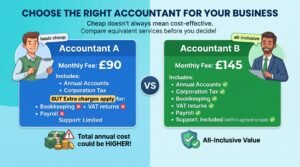
You receive two quotations:
| Service | Accountant A | Accountant B |
|---|---|---|
| Monthly fee | £90 | £145 |
| Annual accounts | Included | Included |
| Corporation Tax return | Included | Included |
| Bookkeeping | Extra | Included |
| VAT returns | Extra | Included |
| Payroll | Extra | Included |
| Ongoing support | Limited | Included within agreed scope |
Accountant A appears cheaper. However, once you add the extra charges for bookkeeping, VAT and payroll, the total annual cost could be higher.
Accountant B may therefore offer better value for your particular requirements.
This does not mean the more expensive accountant is always better. It means you should compare equivalent services before making a decision.
3. Common Mistakes & Pitfalls When Choosing an Accountant
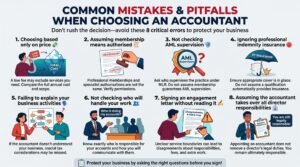
Choosing based only on price
A low fee may be attractive, but it could exclude services your business needs. Compare the full annual cost and scope.
Assuming membership means every service is authorised
Professional membership, practising certificates and specialist authorisations are not necessarily interchangeable. Verify the permission relevant to the work you need.
Not checking AML supervision
Ask who supervises the practice under the Money Laundering Regulations. Do not assume professional membership automatically confirms AML supervision in every case.
Ignoring professional indemnity insurance
Ask for confirmation that appropriate cover is in place for the services being provided. Do not assume that a qualification alone provides insurance protection.
Failing to explain your business activities
If the accountant does not understand your business model, important accounting and tax considerations may be overlooked.
Not checking who will handle your work
You should know who is responsible for your accounts and how you will communicate with them.
Signing an engagement letter without reading it
Unclear service boundaries can lead to disagreements about fees, responsibilities and additional work.
Assuming the accountant takes over all director responsibilities
Appointing an accountant does not remove a company director’s legal responsibilities. Directors remain responsible for ensuring their company meets its statutory obligations.
4. Practical Recommendations & Next Steps
Before choosing an accountant, use this checklist:
- Identify the qualifications and professional body membership.
- Verify the relevant membership and practising status.
- Ask about AML supervision.
- Confirm professional indemnity insurance.
- Check experience relevant to your business.
- Request a detailed service breakdown.
- Compare the total annual cost.
- Understand the communication and reporting arrangements.
- Review the engagement letter and complaints process.
- Make sure you are comfortable discussing your financial circumstances with the accountant.
Questions to ask during an initial consultation
You can use these questions when speaking to prospective accountants:
- What experience do you have with businesses like mine?
- Which services are included in your quotation?
- Who will be handling my accounts?
- How often will my bookkeeping be updated?
- Can I contact you directly when I have a question?
- How do you deal with HMRC correspondence?
- What happens if my business grows or its requirements change?
- Are there any additional fees I should know about?
The best accountant for your business is not necessarily the largest firm or the cheapest provider. It is the professional whose qualifications, experience, service scope and working arrangements match your requirements.
Ten Piece Limited (TPL) – The Trusted Accounting Partner
Ten Piece Limited is licensed and regulated by the AAT (License No. 1009076) and supervised under HM Treasury Money Laundering Regulations. Ten Piece Limited – The Trusted Accounting Partner. Based in London, we provide professional accounting, taxation and business advisory services to individuals, sole traders, entrepreneurs, start-ups, company directors and businesses across London, Greater London and throughout the UK. Our services include bookkeeping, VAT registration and returns, payroll management, annual accounts, Corporation Tax returns, Self Assessment, tax planning, financial reporting and Xero accounting support. We believe everyone deserves access to professional accounting advice, regardless of their income, occupation, financial circumstances or source of earnings. Whether you run an established company, are starting your first business, work as a freelancer, earn through content creation or have multiple income streams, our approachable and non-judgemental team is here to listen, understand your circumstances and provide practical, tailored advice. We pride ourselves on being easy to talk to, offering clear guidance and treating every client’s personal and financial information with the utmost confidentiality and discretion, subject to applicable legal and regulatory obligations. Whether you are looking for a reliable accountant in London, affordable accounting services for your limited company, better bookkeeping support, professional tax advice or a new accountant who genuinely understands your needs, Ten Piece Limited is here to help. Contact us today for a personalised quotation and discover accounting support built around you and your business.
Engagement & Call to Action
Ready to simplify your accounting processes and optimize your tax strategy? Contact Ten Piece Limited today at +44 20 8050 5527, email hello@tenpiece.co.uk, or visit tenpiece.co.uk to request a customized quote or schedule a consultation with our expert team.