

Is the UK Tax System Making It Harder for Small Businesses to Survive and Grow?
Starting a business is difficult enough. Finding customers, managing cash flow, paying suppliers and keeping operations running already demand considerable time and effort. Yet, over recent years, the financial and administrative responsibilities facing UK small businesses have changed significantly.
The tax advantages traditionally associated with running a limited company have become less straightforward, while sole traders are being brought into a more demanding digital reporting environment. The result is a business landscape where choosing the right structure requires more careful financial planning than ever before.
So, is the UK tax system making it harder for small businesses to operate, invest and grow? Let’s examine the figures and what they mean for business owners.
2. The Tax Advantages of Running a Limited Company Have Changed
For many years, incorporating a business was an attractive option once profits reached a certain level. A limited company could pay Corporation Tax on its taxable profits, while the director could extract money through a combination of salary and dividends.
Depending on the circumstances, this could produce a more favourable overall tax position than operating as a sole trader.
However, several changes have altered that calculation.
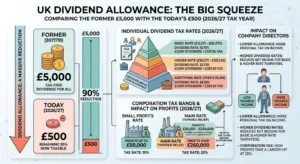
The dividend allowance has fallen from £5,000 to £500.
This is a substantial reduction in the amount of dividend income an individual can receive each tax year before dividend tax becomes payable. The allowance is now considerably less generous than it was when many business owners first considered incorporation.
Dividend tax rates have also changed. For the 2026/27 tax year, the rates are:
- Basic-rate taxpayers: 10.75%
- Higher-rate taxpayers: 35.75%
- Additional-rate taxpayers: 39.35%
The amount payable depends on the individual’s total taxable income and available allowances.
Corporation Tax has also moved away from the previous single-rate structure. Companies generally pay 19% on qualifying taxable profits up to £50,000 and 25% where taxable profits exceed £250,000. Marginal relief can apply between these thresholds.
Importantly, these thresholds may be reduced where a company has associated companies or an accounting period shorter than 12 months.
It is therefore misleading to suggest that every company pays 25p in Corporation Tax on every pound it earns. Corporation Tax is calculated on taxable profits, not turnover.
Nevertheless, the combined effect of Corporation Tax and the personal tax paid when extracting profits means that the old assumption that incorporation automatically saves tax is no longer reliable.
3. Going Limited Is Increasingly About Protection and Long-Term Financial Planning
If the tax advantages of incorporation have become less predictable, why would someone still choose to operate through a limited company?
Because tax savings are only one part of the decision.
A limited company is a separate legal entity. This can provide shareholders with limited liability, helping separate business obligations from personal finances. However, this protection is not absolute. Personal guarantees, certain director liabilities and other legal obligations can still expose individuals to personal financial risk.
There are also opportunities for longer-term financial planning.
For example, an employer pension contribution made by a limited company can be an effective way to build retirement savings, provided the contribution meets the relevant tax requirements. A company can also retain profits for future investment rather than distributing all available funds to its shareholders.
However, incorporation comes with additional responsibilities.
These include:
- Preparing and filing statutory accounts.
- Submitting Corporation Tax returns.
- Maintaining company records.
- Meeting Companies House filing requirements.
- Managing payroll and dividend documentation where applicable.
- Paying for ongoing accounting and compliance support.
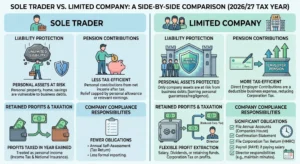
For a business owner considering incorporation, the cost of an accountant for a limited company UK business should therefore form part of the calculation, alongside the potential tax and financial benefits.
This is where professional accounting services for small business UK companies become particularly valuable. The objective should be to understand the complete financial position rather than focusing on one headline tax rate.
4. Making Tax Digital Is Changing the Sole Trader Experience
Traditionally, one of the biggest attractions of operating as a sole trader was simplicity.
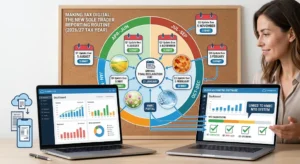
A business owner could maintain bookkeeping records throughout the year and submit one Self Assessment tax return after the tax year ended. Although accurate records were always necessary, the reporting process was relatively straightforward.
That is changing with Making Tax Digital for Income Tax.
From 6 April 2026, qualifying sole traders and landlords with gross qualifying income above £50,000 must use Making Tax Digital for Income Tax.
This requires them to:
- Maintain digital business records using compatible software.
- Submit quarterly updates to HMRC.
- Complete the annual tax return or final declaration through the digital process.
- Continue paying tax under the existing payment deadlines.
The quarterly updates do not replace the annual tax return. Instead, they introduce additional reporting throughout the year.
The qualifying-income thresholds are also scheduled to reduce:
- Above £50,000: from April 2026.
- Above £30,000: from April 2027.
- Above £20,000: from April 2028.
An important distinction is that qualifying income is generally the gross income from self-employment and property before expenses, rather than taxable profit. Employment income and dividends are not included in this calculation.
For smaller businesses, this means additional bookkeeping discipline, compatible software and more regular interaction with accounting records.
Cloud accounting services can make the process more manageable by allowing business owners to record transactions, reconcile bank accounts and maintain digital records throughout the year.
However, software alone does not remove the need for proper bookkeeping. Incorrect categorisation, missing transactions and poor record-keeping can still lead to inaccurate reporting.
Image suggestion: A quarterly reporting calendar showing four HMRC update deadlines, connected to a laptop displaying cloud bookkeeping software, to demonstrate how Making Tax Digital changes the sole trader’s reporting routine.
Suggested image alt text: Making Tax Digital quarterly reporting calendar for UK sole traders and landlords using cloud accounting software.
5. Sole Trader or Limited Company: Which Structure Makes Financial Sense?
The traditional question of whether to operate as a sole trader or limited company now requires a more detailed assessment.
There is no single profit level at which incorporation automatically becomes the right decision. The outcome depends on the owner’s circumstances, tax position and plans for the business.
A sole trader may still benefit from a relatively straightforward business structure, fewer statutory company obligations and lower administration costs.
A limited company may be more appropriate where the owner wants a separate legal entity, expects to retain profits, intends to make employer pension contributions or needs a structure that supports future investment and growth.

A proper comparison should consider:
- Business profits: How much does the business generate after allowable expenses?
- Personal drawings: How much money does the owner need to take out each year?
- Tax liabilities: What are the combined Income Tax, National Insurance, Corporation Tax and dividend tax consequences?
- Pension planning: Could employer pension contributions form part of the financial strategy?
- Business risk: Does the nature of the work justify a separate legal structure?
- Compliance costs: What are the accounting, bookkeeping, software and filing costs?
- Future plans: Does the owner intend to hire employees, retain profits or expand operations?
This is why an accountant should not recommend incorporation based solely on a headline profit figure.
A suitable business tax advisory review should compare the actual financial consequences of both structures, including the costs that are often overlooked.
At Ten Piece Limited, we are developing a finance course and a comparison calculator to help business owners assess whether operating as a sole trader or through a limited company makes financial sense for their circumstances.
The aim is to replace assumptions with a clear comparison of the numbers.
Image suggestion: A modern decision-making infographic showing sole trader and limited company options, with profit, personal drawings, tax, pension contributions, liability and compliance costs as comparison factors.
Suggested image alt text: Sole trader versus limited company calculator comparing UK business tax, profits and accounting costs.
Conclusion: Small Businesses Need Better Financial Planning, Not More Assumptions
It is understandable why many business owners feel that running an independent business has become more complicated. The reduction in the dividend allowance, changes to dividend taxation, Corporation Tax bands and the introduction of Making Tax Digital have all changed the financial and administrative landscape.
However, the answer is not to assume that every business should incorporate or that every sole trader is now worse off. Each structure has advantages, costs and obligations that need to be assessed individually.
The more important question is whether business owners are making decisions using current financial information rather than relying on tax advice that may have been appropriate several years ago.
This is where a good accountant brings value beyond filing tax returns.
Through bookkeeping services, cloud accounting, tax consultancy, business tax advisory and tax compliance and advisory services, accountants can help owners understand their numbers, manage risks and plan for sustainable growth.
For a small business, the right decision is not necessarily the structure with the lowest immediate tax bill. It is the structure that supports the owner’s financial position, protects the business appropriately and allows it to grow.
Small businesses need to understand their numbers before making their next big decision.