

The way a couple extracts money from a family-owned limited company can make a significant difference to their overall tax position. By combining salaries with dividends, two genuine shareholders may be able to withdraw around £100,000 in a tax year while keeping their combined personal Income Tax bill close to £8,000.

But there is more to this calculation than simply paying two salaries and splitting dividends. The share ownership must be genuine, the company must have sufficient profits, and the tax figures need to be understood in the context of the 2026/27 tax year.
1. How the £100,000 Extraction Works
Consider a limited company owned equally by a couple, where both individuals genuinely own shares carrying the relevant dividend rights.
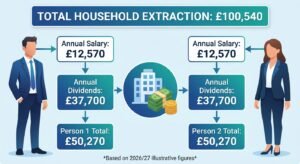
For this illustration, each person receives:
-
Annual salary: £12,570
-
Annual dividends: £37,700
-
Total income per person: £50,270
Together, their household income from the company is:
| Payment | Person 1 | Person 2 | Combined |
|---|---|---|---|
| Salary | £12,570 | £12,570 | £25,140 |
| Dividends | £37,700 | £37,700 | £75,400 |
| Total | £50,270 | £50,270 | £100,540 |
The structure uses each person’s £12,570 Personal Allowance and keeps their total income within the basic-rate threshold for England, Wales and Northern Ireland.
The important point is that the dividends are paid to two genuine shareholders, rather than simply being allocated between two people for tax purposes.
2. How Does the Personal Tax Bill Reach £7,998?
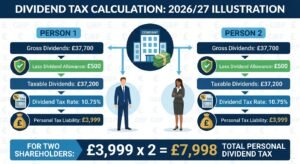
For the 2026/27 tax year, the dividend ordinary rate is 10.75%, and each individual has a £500 annual dividend allowance.
Using the figures above, each person receives £37,700 in dividends. After deducting the £500 dividend allowance, £37,200 remains taxable.
The calculation for each shareholder is:
-
Dividends received: £37,700
-
Dividend allowance: £500
-
Taxable dividends: £37,200
-
Dividend tax rate: 10.75%
-
Personal dividend tax: £3,999
For two shareholders, the combined personal dividend tax is therefore:
£3,999 × 2 = £7,998.
The salaries are assumed to be covered by each person’s £12,570 Personal Allowance, so there is no Income Tax on those salaries in this simplified illustration.
This is how the couple can receive £100,540 from their company with a combined personal Income Tax bill of approximately £8,000.
However, this calculation assumes both individuals are entitled to the full allowances and have no other income affecting their tax position. Scottish taxpayers may also have different income tax bands, so individual circumstances matter.
3. The Important Part: Corporation Tax, National Insurance and Genuine Share Ownership

There is an important distinction between personal tax and the company’s tax liabilities.
The £7,998 figure is the couple’s estimated personal dividend tax. It is not the total tax cost of extracting the company’s profits.
Dividends are paid from profits available for distribution after Corporation Tax. They are not deductible expenses when calculating the company’s Corporation Tax liability. The company must also have sufficient distributable profits and follow the correct dividend procedures.
Salary has a different treatment. It is normally a deductible business expense where it is incurred wholly and exclusively for the company’s trade, but it must be properly processed through payroll. Employer National Insurance may also apply.
For 2026/27, the employer National Insurance secondary threshold is £5,000 and the standard employer rate is 15%. Therefore, a salary of £12,570 can create an employer National Insurance cost unless an available relief or allowance reduces it. The company’s position should be checked before adopting this salary level.
Share ownership is equally important. Both individuals must genuinely and beneficially own shares carrying the relevant dividend rights. The company must respect the rights attached to those shares and document dividends correctly.
For spouses, an outright gift of shares can be effective in appropriate circumstances, but arrangements that only transfer an entitlement to income without genuine ownership may raise questions under the settlements legislation.
4. Why This Is Not a One-Size-Fits-All Tax Strategy

Although the example demonstrates how salary and dividend planning can work, it should not be treated as a standard formula for every limited company.
The most suitable salary depends on the company’s circumstances, available allowances, National Insurance position and the wider tax situation of each director.
The same applies to dividends. A company cannot simply pay whatever amount it chooses. Payments must be supported by available distributable profits, follow the company’s articles of association and reflect the rights attached to the shares.
Other income, pension contributions, student loan repayments and changes in tax legislation can also affect the final outcome.
A calculation that looks efficient on paper may not be the most appropriate option once the company’s full position is considered.
Looking Ahead: Why Professional Tax Planning Matters

Extracting profits from a limited company is not simply about choosing between salary and dividends. It requires an understanding of Corporation Tax, Income Tax, National Insurance, company law and the rights of shareholders.
At Ten Piece Limited, we help directors and business owners review their remuneration structures, understand their tax exposure and plan how to extract company profits efficiently and compliantly.
The key is to plan before taking the money out. A properly structured remuneration strategy can help avoid unnecessary tax costs while ensuring that the company meets its legal and reporting responsibilities.